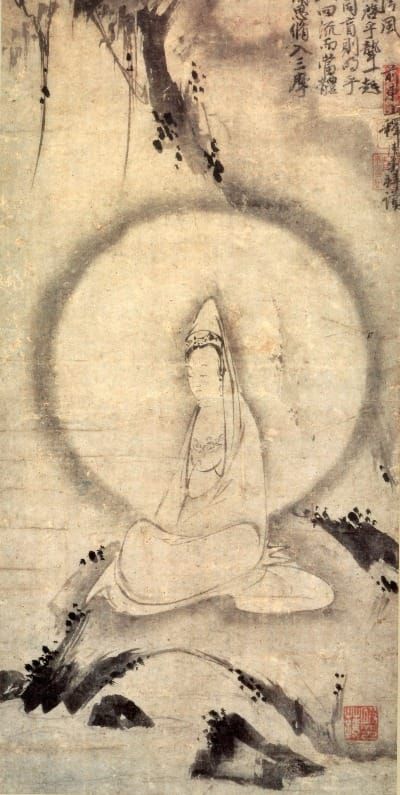
White-Robed Kannon by Kichizan Mincho (1351-1431) from Awakenings: Zen Figure Paintings in Medieval Japan
The Vine of Obstacles Zen training group is into another round of studying the Sixteen Bodhisattva Precepts and "Formless Atonement" (aka, "repentance") is first:
🙏
"All the karma ever created by me since of old/through beginningless greed, anger, and ignorance/born of my body, speech and thought/I now fully and openly atone with it all."
"Repentance," said Katagiri Roshi (1928-1990), "is to be present right in the middle of peace and harmony. It is the perfect openness of our hearts that allows us to hear the voice of the universe beyond the irritation of our consciousness. Repentance, itself, makes our life perfectly peaceful."
In order to practice repentance and make our life peaceful, Katagiri Roshi taught that kanno doko ("the interacting communion of appeal and response," 感應道交) is an essential element. The practice of kanno doko integrates self-power (自力) and other-power (他力 ) as call and response arise together. Or as Dongshan said, "Drumming and singing begin together."
"Formless Atonement" and kanno doko have been an essential aspect of Zen practice for me for most of my forty-seven years, especially when the path has been rough and wild - or simply difficult to find. Fortunately, "Formless Atonement" and kanno doko are embedded in the training container that Katagiri Roshi taught, specifically through the recitation of "The Founding Ancestor Eihei’s Verse for Arousing the Vow" (see below for excerpts).
In this post, I'll offer resources and inspiration, I hope, for your practice of kanno doko, much like my recent post on shugyo, including the teaching of Katagiri Roshi, Kokyo Henkel Osho, Zhiyi, Tetsugan Sensei, Yasutani Roshi, Dogen Zenji, and Bodhidharma. I'll also include one student example from our Vine discussion. And finally, I'll offer a couple suggestions for engagement from readers like you.
By the way, the writing process for this post was an example of kanno doko. One specific way this manifested was how my silent appeal for kanno doko resources led to a number of wonderful resources manifesting, especially in my ongoing discussions with Tetsugan Sensei, contributions from Vine students, and documents from Kokyo Henkel Osho (some already on my computer drive, but not in my retrievable bio-memory). Below, I've starred the offerings from Kokyo with a *️⃣.
For starters, here is an excellent kanno doko essay by Kokyo, "Mystical Communion, Meeting Buddha" *️⃣:
Kanno doko is a pure form of deeply heartfelt prayer that leaps beyond subject and object (i.e., prayer and prayed to). However, because kanno doko is translated in many different ways, you may have missed the prominence of this important practice in the Zen tradition. I say this because I sometimes hear practitioners say that there isn't a prayer practice in Zen.
Here are a few of those alternative translations: "mystical communion," "sympathetic resonance" "empathy and response," "mutual resonance between stimulus and response," and "mutual attraction between buddhas and sentient beings" *️⃣.
Katagiri Roshi creatively unpacks the four characters in kanno doko like this: "kan means appeal, no is response, do is path, ko is to cross. Appeal and response cross very quickly. This is wholeheartedness, exactly."
Praying quietly
As we've explored repentance and kanno doko on the Vine, I believe we were all moved by the heartfelt quality of the many student expressions of appeal and response that appeared in our study forum. For example, one student shared this:
🙏
"Last week, I stopped on the way to work to do zazen outside for twenty minutes, as is my habit lately. The morning was still freezing cold. I was shivering, and my zazen was not feeling stable. I had that sense of 'this is not working' – both the zazen, and my life in general. When I got up to walk toward the office, I started praying quietly, letting the words fill the body, letting the words do the walking. It was some repeated phrase like 'I give myself completely to this.' After walking just a few steps, I saw some blossoms on a cherry tree next to the footpath. Immediately, the heart opened. I felt a wave of remorse and relief. I saw how I cloud everything by trying too hard, going too fast, and not completely trusting. Zazen and prayer was the appeal, and the sight of the cherry blossom was the immediate manifest response."
Kanno doko is a term that was probably coined by Zhiyi (538-597) and the practice appears prominently in his work. For example, someone asked Zhiyi about arousing the thought of awakening, saying:
🙏
“'Does the practitioner arouse the thought or is the thought aroused through another’s teaching?' Zhiyi said, 'It is not possible either by oneself, through another, together or separately; it is only through the [communion of appeal and response] that one can speak of the arising of the thought.'”
Zhiyi also said,
🙏
"The water does not rise, nor does the moon descend, yet the one moon in a single instant is manifest in all waters. The Buddhas do not come, and the sentient beings do not go. The power of the capacity of goodness and compassion is to be perceived in this way. Therefore it is called subtle empathy and response.”
Zhiyi taught that there are four types of kanno doko:
🙏
(1) hidden appeal and hidden response; (2) hidden appeal and manifest response; (3) manifest appeal and manifest response; and (4) manifest appeal and hidden response.
This is a rich system that invites us to sit quietly and reflect.
Tetsugan Sensei, in our discussions about kanno doko, noted that "latent" is a better term than "hidden":
🙏
"You may not know you are searching for something, but, paraphrasing Katagiri Roshi, once you have poked your nose into Zen Buddhism, you've kicked off something that will haunt you until you've fulfilled your search. In addition, this is where repaying your debt to the Buddhas and Ancestors comes in. When our appeal is still latent, we are not aware of our debt. The clearer our appeal is, the clearer the response. Once the latent has become manifest, then our debt is palpable - it is clear that we owe something too. If we ignore our debt, it's probably worse than if we hadn't aroused appeal-response to begin with."
Enter Hakuun Yasutani Roshi's teaching
In Rochester Zen Center newsletter, "Zen Bow," from March/April 1969, Yasutani Roshi (1885-1973) offered an article on kanno doko, "The Responsive Communion Between Buddhas and Sentient Beings" *️⃣. In it, Yasutani Roshi says:
🙏
"You have already heard me say that Buddha-nature is indigenous to all, and that Buddhas of the past continue to exist and perfect their own Buddha-nature. Still, if there were no mutual attraction or sympathy between Buddhas and sentient beings, none of us could ever become a Buddha. Just as a seed will not sprout without sunlight or heat or water or soil, so our Buddha-nature seed without the light of the Buddha's wisdom and the waters of their compassion will not grow and flourish."
Yasutani Roshi then goes on to unpack the four types of kanno doko and provides an example of how these four types flow from one to another. This article is so wonderful that I'll share the whole thing with you below. In the attached newsletter, Yasutani Roshi's article is second, following a woman householder's powerful kensho story:
Dogen's "Allow me to practice the Way without hindrance"
Dogen (1200-1253) also emphasized kanno doko *️⃣:
🙏
Dogen’s teacher, Rujing, taught him a verse to silently recite when prostrating to the Buddha: “Bower and bowed to are both naturally empty and still; mystical communion is inconceivable.” Then he said to Dogen, “Please understand the significance of mystical communion. If there were no mystical communion, the buddhas would not have appeared in the world and Bodhidharma would not have come from the West.”
Below you'll find two examples from "The Founding Ancestor Eihei’s Verse for Arousing the Vow" ("Eihei Koso Hotsuganmon," 永平高祖發願文):
🙏
Although my past evil karma has greatly accumulated, indeed being the cause and conditions of obstacles to practicing the Way, may all Buddhas and Ancestors who have attained the Buddha Way, be compassionate and free me from karmic effects, allowing me to practice the Way without hindrance.
And
🙏
Quietly explore the farthest reaches of these causes and conditions, as this is the exact transmission of a verified Buddha. Repenting in this way, one never fails to receive profound help from all Buddhas and Ancestors. Revealing and disclosing one’s lack of faith and practice before the Buddha, the power of this revelation melts away the root of transgressions. This is the pure and simple color of true practice, of the true mind of faith, and the true body of faith.
And finally, the last word from the First Ancestor
Guifeng Zongmi (780–841), an important twelfth-generation successor in China in the Heze succession said this *️⃣:
🙏
“Bodhidharma came from the west only in order to transmit the mind dharma. Thus he himself said: 'My dharma is transmitted from mind to mind and does not depend on words or letters.' This mind is the pure and original awakening of all sentient beings. It is also known as buddha-nature or numinous awakening. If you wish to seek the Way of the Buddhas, you must awaken to this mind. Therefore, the generations of ancestors in this lineage transmit only this. If there is a sympathetic resonance (kanno) and reciprocal tallying [between master and disciple], then although a single flame may be transmitted to a hundred thousand lamps, there will be no difference between them.”
Thank you for reading!
The comment section is open for all paid subscribers. You are invited to share an experience of kanno doko. Also, I'm wondering if you know of kanno doko resources that aren't included above (especially of the Rinzai persuasion)? Share it here in the comments.
🙏
Vine of Obstacles Zen offers writings, like this one, aimed at practitioners who are interested in doing the subtle, thoroughgoing work of the buddhadharma that honors the received tradition. We also offer a training group for householders intent on awakening and the post-awakening process. This training process works best for those interested in practicing with a high degree of integrity within the nitty-gritty details of this life. This would be a good time to explore our approach and see if you find affinity with Tetsugan Sensei and I as teachers, and with the Vine sangha. The first step is to attend some Sunday sessions, 10:00am to 11:15am CDT. The Zoom link for these sessions is shared weekly with paid subscribers. If you are not now a paid subscriber, use the button on the lower right to review your options.
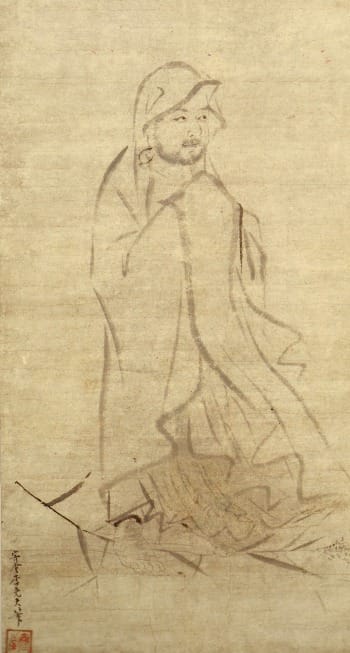
Bodhidharma Crossing the Yangzi River on a Reed, Li Yaofu, Awakenings: Zen Figure Paintings in Medieval Japan